Antisemitism in Poland in 2025.
Trends, Narratives, and the Experiences of the Jewish Community
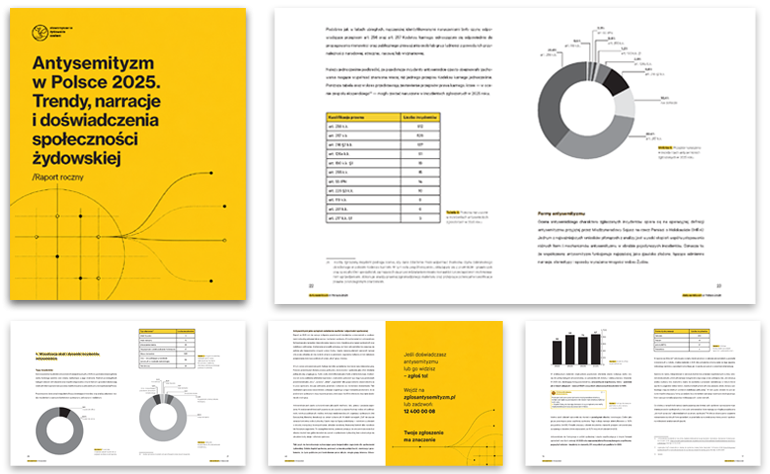
The year 2025 showed that antisemitism in Poland increasingly operates not as isolated statements, but as a recurring mechanism embedded in both online and public discourse.
The Czulent Association’s report analyzes 1,233 reports of antisemitic incidents, of which 1,149 were verified and confirmed through the review process.
The vast majority of verified incidents occurred online. Hate speech was identified in 1,051 reports, accounting for 85.1% of the analyzed material. At the same time, the number of offline incidents increased from 79 in 2024 to 87 in 2025.
Key Figures
1233
antisemitic incident reports analyzed in 2025
1149
verified incidents following the verification process
85,1%
of the analyzed material consisted of hate speech
87
offline incidents recorded in 2025
Key Findings
Antisemitism is Taking New Forms.
Obscene slogans and antisemitic content appeared not only in comments, but also in memes, songs, recordings, and recurring content formats. The number of reports containing recognizable recurring formulas increased from 128 in 2024 to 320 in 2025.
The Growing Prevalence of Holocaust Denial and Distortion.
References to Auschwitz-Birkenau and gas chambers appeared in 45 reports, compared with 26 in the previous year.
Antisemitism Intersects with Other Forms of Prejudice.
In 208 reports, representing 21% of the analyzed material, antisemitism co-occurred with sexism. An anti-Ukrainian element was identified in 77 cases, while 123 reports contained references to Ukraine, Zelenskyy, Bandera, Volhynia, or the “Ukropolin” myth.
Antisemitism Functions as a Conspiratorial Framework and Tool for Mobilization.
The report highlights links between narratives about “foreign influence,” control over public life, “Polin,” and “Ukropolin” and emotions such as fear and anger, as well as broader social polarization. The highest number of incidents was recorded on 18 May 2025, the day of the first round of the presidential election.
Why Monitoring Matters
Effective monitoring of antisemitism requires analyzing not only words, but also images, symbols, codes, and the ways in which content is disseminated. Systematic monitoring helps capture phenomena that do not appear in official statistics and enables a better understanding of the mechanisms through which hateful content is normalized and contributes to radicalization.
Read the Report
Explore the data, narratives, and analysis of the experiences of the Jewish community in Poland in 2025.