Monitoring of hateful content.
2025 Presidential elections in Poland
Antisemitism and Other Hate Speech in Online Election Discourse.
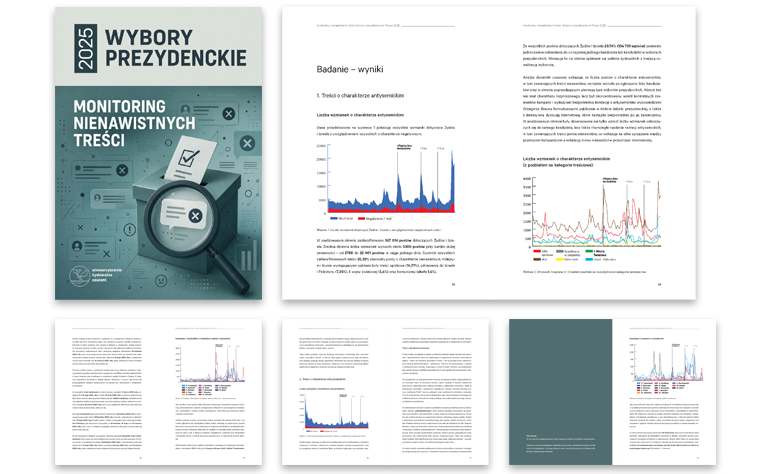
The 2025 presidential election marked a shift in the way antisemitism manifested itself in public discourse. Explicitly antisemitic content appeared directly in the public statements of a candidate for the office of President of the Republic of Poland and became part of the election campaign.
This is the third publication in a series of reports by the Czulent Association monitoring hateful content during election campaigns. In studies of the 2023 parliamentary elections and the 2024 European Parliament elections, antisemitism most often took the form of insinuations, coded language, historical references, and conspiracy myths. In 2025, some of these narratives entered the political mainstream directly.
The report analyses not only content concerning Jews and Israel, but also narratives concerning Ukraine and Ukrainians, refugees, and LGBT+ people. It shows how individual narratives intersected and how their intensity changed at successive stages of the election.
Scale of the phenomenon
567 016
posts concerning Jews and Israel were identified during the period under analysis.
25,33%
of the analysed posts concerning Jews and Israel contained hateful content.
134 735
of the posts concerning Jews and Israel also referenced at least one candidate.
115 191
of the posts concerning Ukraine and Ukrainians referenced at least one candidate.
9,85% → 19,53%
the share of posts concerning Ukraine and Ukrainians that also referenced candidates increased by this amount between the pre-campaign period and the campaign period.
179 879
posts concerning LGBT+ people were analyzed for the period from 1 March to 15 June 2025.
What does the monitoring reveal
Antisemitism became a direct part of the electoral campaign.
The volume of antisemitic content increased significantly after the announcement of the candidate list and again in the period leading up to the first round of the election. This increase was associated with public antisemitic statements by Grzegorz Braun and the subsequent intense online discussion.
Jewish-related narratives became closely intertwined with electoral competition
23.76% of all posts concerning Jews and Israel contained a reference to at least one candidate. Among these posts, content referring to Grzegorz Braun, Rafał Trzaskowski, Karol Nawrocki, and Sławomir Mentzen accounted for the largest shares.
Anti-Ukrainian narratives became part of the electoral competition.
During the campaign period, the share of posts concerning Ukraine and Ukrainians that also referred to candidates nearly doubled. The analysis indicates that the increased activity surrounding some candidates was primarily associated with a rise in hateful or disinformation-related content.
Different forms of prejudice converged into broader narratives
In the analyzed content, antisemitic and anti-Ukrainian narratives frequently co-occurred, forming conspiratorial frameworks that portrayed different minority groups as part of a single, interconnected threat.
The campaign reinforced existing narratives.
High levels of negative and hateful content were also evident both before the formal start of the campaign and after its conclusion. Rather than generating entirely new narratives, the campaign primarily acted as a catalyst for existing ones, amplifying their visibility and intensity.
Three Campaigns, Three Stages of Monitoring
The 2025 presidential election report concludes a three-year cycle of monitoring electoral campaigns. The successive studies make it possible to track how hateful content evolves, which groups are incorporated into political narratives, and how prejudice and disinformation operate within online political discourse.
Key Findings from the Study
The monitoring findings underscore the urgent need for a systemic response to hateful and disinformation-related content in the digital space.
- greater accountability for political actors for the language they use in public discourse;
- skuteczniejszych mechanizmów moderacji treści na platformach społecznościowych;
- more effective content moderation mechanisms on social media platforms;
- strengthening media literacy and the skills needed to identify disinformation and hateful content.
These efforts should simultaneously safeguard freedom of expression and human rights in the digital space.
Read the Report
Explore the monitoring findings, analysis of content targeting specific groups, and data illustrating the dynamics of hateful narratives during the 2025 presidential election.