Subject
available languages
Date of publication
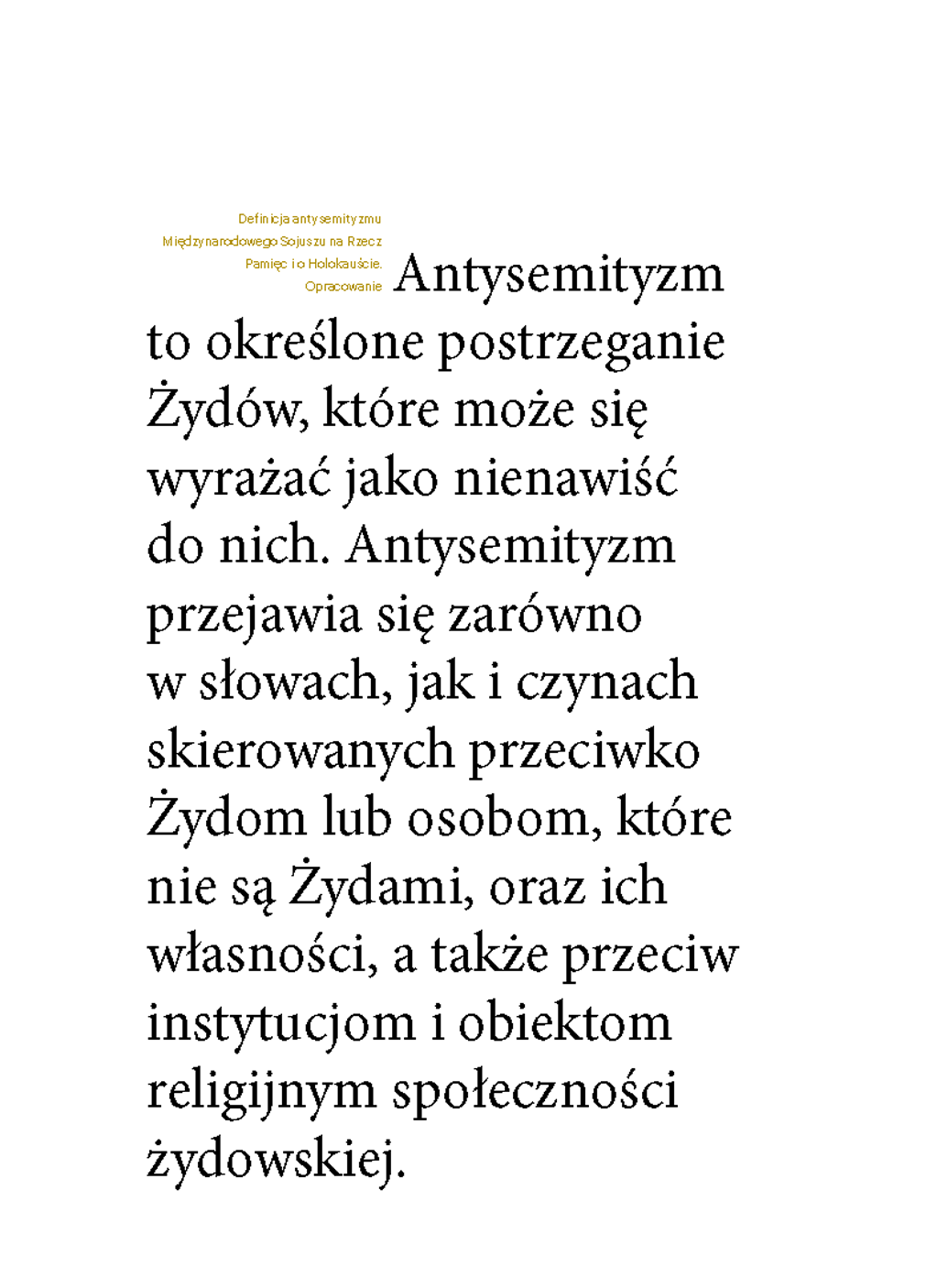
IHRA non-legally binding working definition of antisemitism. Study
The IHRA definition of antisemitism—a tool that organizes and strengthens effective action
Antisemitism and other forms of discrimination—such as racism, anti-Roma discrimination, or homophobia—have not disappeared from public life. On the contrary, they are taking on new forms and increasingly elude clear-cut assessment.
A response to these challenges is a publication prepared by a coalition of organizations: Beit Polska – Union of Progressive Jewish Communities, the Jewish Association Czulent, and the Catholic Intelligentsia Club, with the support of the Jewish Community of Warsaw.
It is a practical tool addressed to public institutions, social organizations, and individuals working with people experiencing discrimination. It helps to recognize the phenomenon of antisemitism and to build a common framework for action—based on a clear, operational definition.
Why do we need a common definition?
The lack of a consistent understanding of antisemitism leads to fragmented actions and an ineffective response system. The publication shows that:
- without a common language, it is difficult to identify the phenomenon,
- differences in interpretation hinder cooperation between institutions,
- people experiencing discrimination do not always receive adequate support.
The IHRA working definition of antisemitism addresses this gap—it helps to structure both thinking and action.
That is why the definition is at the center of the publication—but understood differently than usual. Not as an abstract concept, but as a tool. Something that organizes reality and enables action. The IHRA definition serves here as a common point of reference—a language that facilitates collaboration between institutions, organizations, and individuals working to address various forms of prejudice.
From theory to pracise – how definition works
The publication explains in detail how to use the IHRA definition in everyday work. It combines the legal context with practical application and presents:
- good practices for implementing the definition,
- examples of its application in different institutions,
- ways of using it in education, public policy, and intervention activities.
As a result, the definition becomes a practical support tool in everyday work, rather than just a theoretical document.
The IHRA definition of antisemitism—a response to contemporary needs
The Jewish Association Czulent promotes solutions that respond to the real challenges of the contemporary world. At the center of these efforts is the need to create universal tools—such as an operational definition—that enable different actors to operate on a shared, common ground.
A common language is the foundation of effective action. The publication makes it clear: without a shared definition, there can be no effective response. The IHRA working definition of antisemitism is a starting point—a tool that enables better understanding, more accurate identification, and more effective counteraction of discrimination.
Table of contents
- Introduction
- An working definition of antisemitism in international law
- IHRA non-legally binding working definition of antisemitism – best practices
- Bibliography
Cooperation and support
The publication was created as part of the project “Countering antisemitism and other forms of discrimination. Implementing the IHRA’s working definition of antisemitism in Poland” realized within the program “Interfaith/Interethnic Coalition-Building To Combat Xenophobia and Religious-Based Discrimination”, which is executed in the area of activities and financed by the National Democratic Institute Office in Poland.
The project was realized by a coalition including Beit Polska, the Czulent Jewish Association, and the Club of Catholic Intelligentsia, in cooperation with the Jewish Community of Warsaw.