Minority Culture – A Foreign Element or Part of Polish Culture?
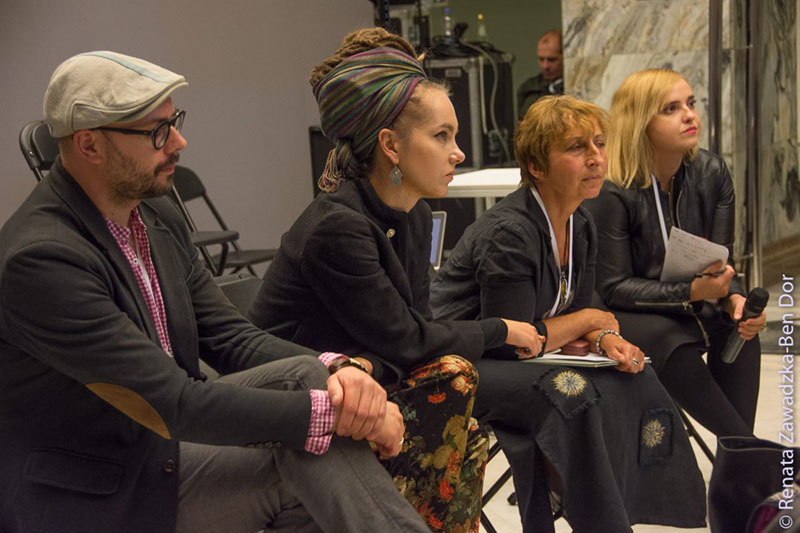
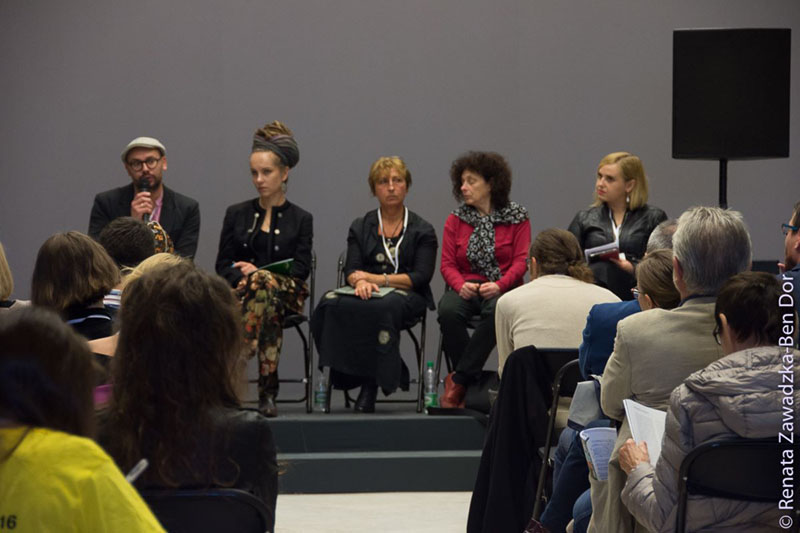
In October 2016, representatives of the Jewish Association Czulent participated in the Congress of Culture. Our organization moderated the debate titled „Minority Culture – A Foreign Element or Part of Polish Culture?”. We invited representatives of the Roma and Lemko communities to the discussion.
The starting point for the discussion was the awareness that the historical heritage of our country and the current culture are not homogeneous. They are also not the product of a single nation. We can be proud of the discoveries of Nicolaus Copernicus, the research of Ludwik Hirszfeld, the inventions of Karol Pollak, and the Hollywood career of Pola Negri.
Minority culture enjoys significant interest in Poland – festivals are organized, and the number of organizations conducting workshops aimed at promoting the culture and traditions of specific groups is increasing. More and more often, young people get involved in educational projects, revitalizing the memory of the „others.” This is problematic because it is done by the majority group towards the minority group – the excluding towards the excluded. These actions tend to interpret the culture and heritage of minorities rather than convey objective knowledge.
This narrative usually focuses on the colorful and „foreign” culture of minorities, rather than on minority cultures as part of Poland’s heritage. The words „Jew” and „Gypsy” in Poland serve as an „abstract negative symbol,” a type of pejorative term that directs or transfers aggression. Recently, words such as „gender,” „multikulti,” and „multiculturalism” have been added to this list. One of the main Polish politicians stated that the attack in Nice was a „consequence of the multikulti policy.”
As D. LaCapra points out, experience is a fundamental issue in minority studies, but there is a danger that it will become an empty slogan, leading to the recovery of lost voices through „projective identifications and speaking for others.” Has Polish society matured enough for minorities to be treated as an integral part of Poland’s cultural landscape? Or is it still the case, as stated in the publication by the Ministry of Foreign Affairs and the Institute of National Remembrance, released for the World Youth Day, titled „1050 Years. A Guide to the History of Poland 966-2016,” where it is stated, among other things, that „numerous national minorities were one of the most important problems of the Commonwealth”?
The congress took place in Warsaw from October 7th to 9th, 2016, at the Palace of Culture and Science.
similar projects